miggiddymatt.com › Sports for non-athletes
I came to disc golf late and approached it the wrong way — by starting at Richmond Hill. Here's what I've learned about the courses around Asheville, ranked by how likely they are to destroy your confidence on the first visit.
Disc golf is one of those sports that sounds extremely casual until someone takes you to a real course and you spend two hours hiking steep mountain terrain while repeatedly throwing a plastic disc into the woods. In western North Carolina, "real course" often means elevation changes that would be considered aggressive on a hiking trail.
I started playing maybe two years ago, mostly as an excuse to be outside with friends on a weekday afternoon. What I didn't expect was to actually get hooked. The mechanics are interesting enough to stay challenging without requiring years of athletic investment, the courses are free, and you can carry everything you need in a small bag. It's the most accessible hard sport I've found.
The Asheville area has a genuinely excellent disc golf scene — the WNC Disc Golf Association (WNCDGA) runs regular events and maintains several of the local courses, and there are enough varied options within thirty minutes of downtown that you could play a different course every weekend for months. Here's my honest take on the three I keep coming back to, in order from "bring a friend who's done this before" to "maybe start somewhere easier."
Lake Julian — start here. Flat-ish, scenic, dog-friendly, and the poison ivy situation is manageable. The course wraps around the lake and mixes open waterfront holes with some tighter wooded sections. Twenty holes. A good place to learn the basic throws without immediately losing three discs in a ravine.
Richmond Hill — the local classic. 18 holes in Richmond Hill Park, tight and wooded with significant elevation change. This is the course the WNCDGA calls home and it regularly hosts PDGA tournaments. Beautiful, but it will punish loose throws. That gorge on the back nine is not forgiving.
Mars Hill — for when you're ready. Twenty minutes north of Asheville on the Mars Hill University campus. Rated Hard on UDisc. Drastic elevation, quick greens, mandatory throws (mandos), and navigation that requires either a local guide or a printed map. The views from hole 7 are worth whatever score you post.
18 holes, 184 acres, tight wooded fairways, elevation changes on nearly every hole, and a poison ivy situation that is not theoretical. Richmond Hill is the best disc golf course in the Asheville area and also the least forgiving.
Richmond Hill Park sits just north of downtown Asheville, and the disc golf course occupies a heavily wooded, deeply hilly section of its 184 acres. The original course dates to 2000, was redesigned in 2006 when the layout had to move to make way for an armory, and took a significant hit from Hurricane Helene in 2024 before reopening with upgrades including new concrete tee pads. It's been a local institution for twenty-five years and it still earns every bit of its reputation.
The course plays differently than almost anything else in the area. The canopy is dense — mostly pine and hardwood — which means the shots that look open from the tee are rarely as open as they appear. Seventeen of the eighteen holes have alternate pin positions, so the layout changes regularly and you can play the same course multiple times without it feeling identical. The elevation changes are not gentle. There are holes where you're throwing down into a gorge and holes where you're throwing uphill into a tunnel of trees, and the course designer was clearly not interested in making any of it easy.
What makes Richmond Hill special is that it rewards precision over power. This isn't a course where you can muscle your way through. The tight fairways punish anything that drifts, and the rough — which is where the poison ivy lives — is genuinely punishing. After a few rounds you start to develop a feel for which holes are forgiving and which ones are traps, and that learning curve is part of what keeps people coming back.
The WNCDGA runs Tuesday Afternoon Random Draw Doubles here regularly, which is a good way to get paired with experienced players who can show you the lines. For a first visit, bring someone who's been before, wear long pants regardless of the weather, and don't try to hero any of the gorge shots until you've seen where the disc goes when it misses.
View on UDisc ›18 holes on a university campus 20 minutes north of Asheville. Rated Hard. Six par fours. Signature hole 7 with a 400-foot top-of-the-world shot overlooking Bailey Mountain. Bring a map or bring a local.
Mars Hill University is about twenty minutes north of Asheville on US-19/23, and the disc golf course wraps around the back of the campus across approximately thirty acres of mountain terrain. The layout includes 43 tee pads and 34 basket placements, which means the course can be configured in a staggering number of ways — the version you play today might be meaningfully different from the version you played six months ago.
The course is rated Hard on UDisc, and that rating is accurate. There are six par fours, which is unusual in disc golf and signals right away that this isn't a course designed for casual rounds. The greens are fast — the campus is maintained to a high standard and the grass is kept short — which means approaches that would be routine on other courses become delicate. Miss the green at Mars Hill and you're often dealing with a significant slope.
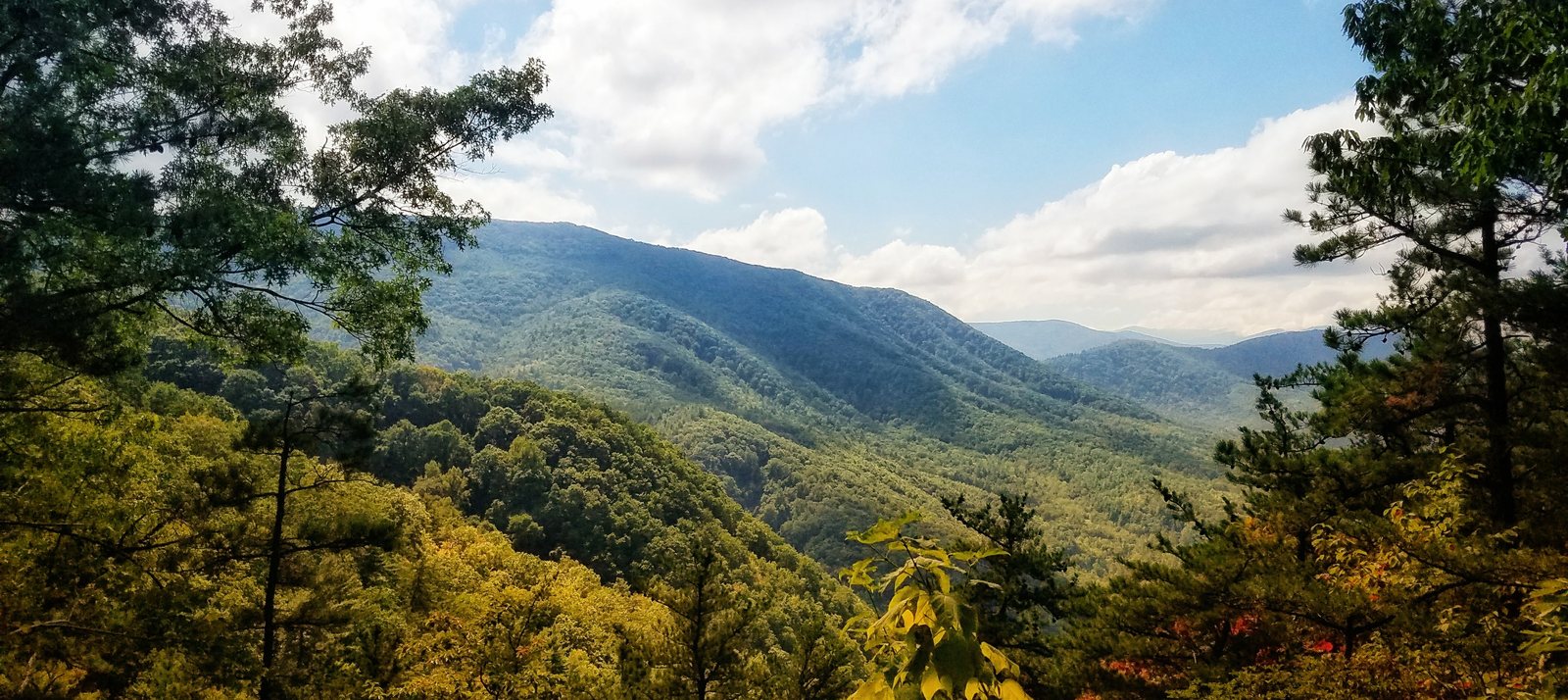
The signature feature is hole 7. From the tee, you're standing at elevation looking out over a valley with Bailey Mountain in the background, and the throw is a long shot out into open air before the disc has to find its way back to the basket. When conditions are right and the shot comes off, it's one of the most satisfying throws in the area. When it doesn't come off, you're hiking.
Navigation is the main challenge for first-timers — the course winds through the campus in a way that isn't intuitive, and the signage is adequate but not generous. The advice from every veteran Mars Hill player is the same: bring someone who's played it before, or at minimum take a photo of the map at hole 1 before you start. The holes between 11 and 13 in particular have a way of sending unfamiliar players in the wrong direction entirely.
The reward for figuring it out is one of the more distinctive playing experiences in western NC. The blend of open manicured fairways, tight wooded holes, elevation drama, and mandatory throws keeps every round interesting. After your round, the town of Mars Hill has a few bars and restaurants within walking distance of campus, which is a reasonable way to finish a hard afternoon.
View on UDisc ›20 holes around a lake in south Asheville. Dog-friendly, cart-friendly, flat enough to be approachable, and interesting enough to be worth repeating. The best entry point to disc golf in the area.
Lake Julian Park is in Arden, about ten minutes south of downtown Asheville, and the disc golf course wraps around the lake and through the surrounding park. The course was originally nine holes and expanded to eighteen in 2017 — it now plays twenty holes, which is an unusual number that always seems to catch people off guard when they think they're almost done.
What makes Lake Julian the right starting point for newer players is that the terrain is actually manageable. The course has some elevation and some tight wooded holes, but it's not designed to be brutal. Several of the holes along the water give you room to work with, and the overall layout is forgiving enough that you can focus on developing your throws rather than just surviving the course.
The lake elements add a visual interest that Richmond Hill and Mars Hill don't have — there's something inherently pleasant about standing at a tee with water in the background, even if a bad throw means you're watching your disc skip across the surface. Water is in play on a number of holes, which adds a real penalty for errors without being relentlessly punishing the way the gorge at Richmond Hill can be.
Practically: Lake Julian is dog-friendly and cart-friendly, which opens it up to a wider crowd than the steep wooded courses. The park itself is a legitimate destination — there's a lake loop trail, fishing, and picnic areas — so it's easy to make a full afternoon of it. The course shares the park with hikers and walkers, so you're threading your rounds around other users, but it's generally well-managed and the traffic isn't a problem on weekday mornings.
The poison ivy situation at Lake Julian is present but less aggressive than Richmond Hill. Still worth long pants on the wooded holes, but the risk of blundering into a patch is lower. For a first round, this is where to go.
View on UDisc ›10.45 miles and 1,715 feet of climbing at Black Mountain — one of those rides where the trail wins and you're okay with it.
Kitsuma is one of those trails that has a reputation in Black Mountain — and on this August morning it earned every bit of it. The heat was already building by 9am and the trail wasted no time reminding me why I'd been avoiding the climbing sections all summer.
The Kitsuma trail itself is relentless uphill — tight switchbacks through rhododendron tunnels, loose rocks that find a way under your front wheel at the worst possible moment. By the time I hit the top I was properly cooked. But the descent off the back side is one of the best pieces of singletrack in the area — fast, flowy, with just enough tech to keep you honest.
Nearly 1,700 feet of climbing in 10 miles on a late August day in western NC. The trail won. I came back for more two weeks later.
View on Strava ›14 miles, 1,594 feet of climbing, and a navigational situation that turned a planned 2-hour ride into nearly 3. Dupont State Recreational Forest is beautiful. It's also easy to get turned around in.
Dupont has a trail network that looks manageable on the map and is absolutely not manageable when you're deep in it without cell service and every junction looks like the last one. This was supposed to be a straightforward loop. It became an adventure.
The forest itself is stunning — hardwoods, waterfalls, granite domes, and singletrack that ranges from flowy gravel paths to chunky technical descents. The problem is that the trail intersections are numerous and not always obvious, and on a September day when you're tired and a little dehydrated, left and right start to lose meaning.
I added about 3 miles I didn't plan on. The good news is that those extra miles included some of the best trail in the park — a long ridge traverse with views out toward the south that I wouldn't have found if I'd stayed on route. Getting lost in Dupont has its upsides.
View on Strava ›A November ride in Pisgah — 9.4 miles, 1,234 feet of climbing, and the kind of late-autumn light through bare hardwoods that makes you forget how cold your hands are.
November riding in Pisgah is its own thing. The crowds are gone, the leaves are down so you can actually see the ridge lines through the trees, and the air is cold enough that you're working to stay warm on the climbs and freezing on the descents. Gloves are non-negotiable.
Spencer Gap trail is a classic Pisgah climb — a long, steady grind up to the gap on a jeep road before things get more interesting. Mark set a pace that was slightly too fast for comfort and exactly fast enough to be satisfying.
The descent back down was fast and loose — the kind of Pisgah riding where the trail surface changes every thirty seconds and you're making micro-decisions constantly. A proper late-season ride.
View on Strava ›